
The Ongoing Palestinian Nakba
Palestinians remembering the days of their exodus from their homes
Written by Sofia Camaano Deus
When I came out of the plane in the Israeli airport of Ben Gurion in Tel Aviv. The first thing I saw was a big picture of a little kid crying and on it was written, “Bringing hope to the next generation of Jews around the world”. The next city I visited was Jerusalem, where Israeli flags sprout from the stone walls of the Old City like a reminder for the visitors not to forget where they are. To remember. A recurrent verb while discussing the history of this piece of land. On 14th May Israelis remember their Independence Day and one day after, on 15th May, Palestinians don’t forget the Nakba, their catastrophe.
Jamila recalls, seated in a plastic chair under the shadow of a tree, what she was doing when the Nakba started in 1948. At that time she was 16 years old and wasn’t living in a refugee camp, but rather in Zacarias, her natal village. “It was two in the morning and I was sleeping in my bed when a loud noise woke me up. It was the sound of the bombs, Israeli militias were attacking the town with rockets”, she explains. Jamila spent a long time running away with no clothes and no food. Her six-month-old baby died from hunger. After a period of itinerancy, she arrived in what is known today as Dheisheh refugee camp, at the outskirts of Bethlehem. By that time there were only “trees and stones” in that area. Nowadays, more than 17,000 people are living in this one-kilometre square.
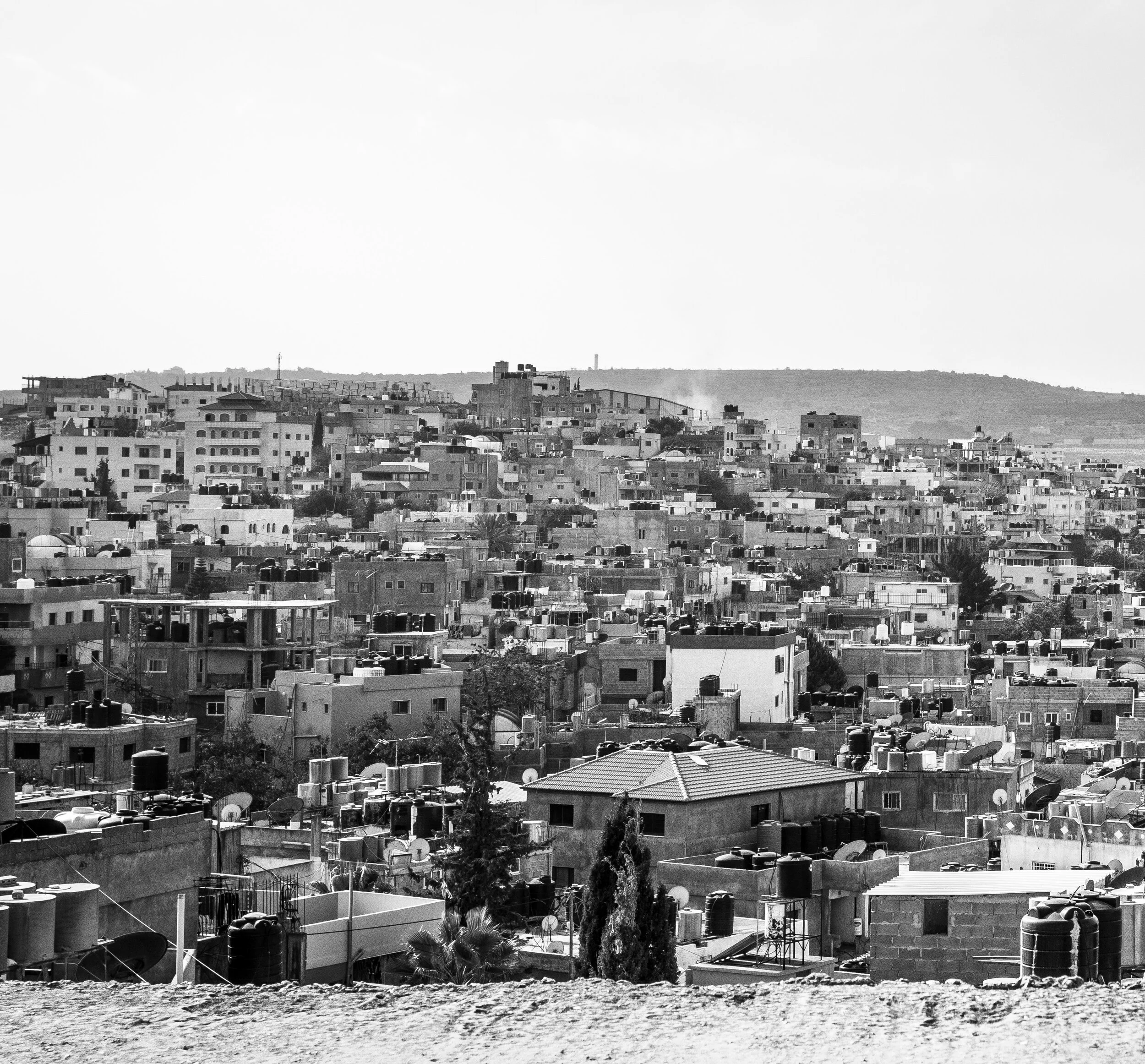
Dheisheh Refugee Camp from a rooftop in 2018. Picture by Pablo Santigo for the book “A land with people”
According to Badil, the Resource Centre for Palestinians Residency and Refugees Rights, more than 750,000 Palestinians were forcibly displaced from their homes and lands during 1948 and prevented from returning. For the people that work in Badil, the Nakba is not reduced to what happened in the past, they rather view it as an ongoing Nakba. The Israeli forces had displaced by the end of 2011 approximately 7.9 million Palestinians.
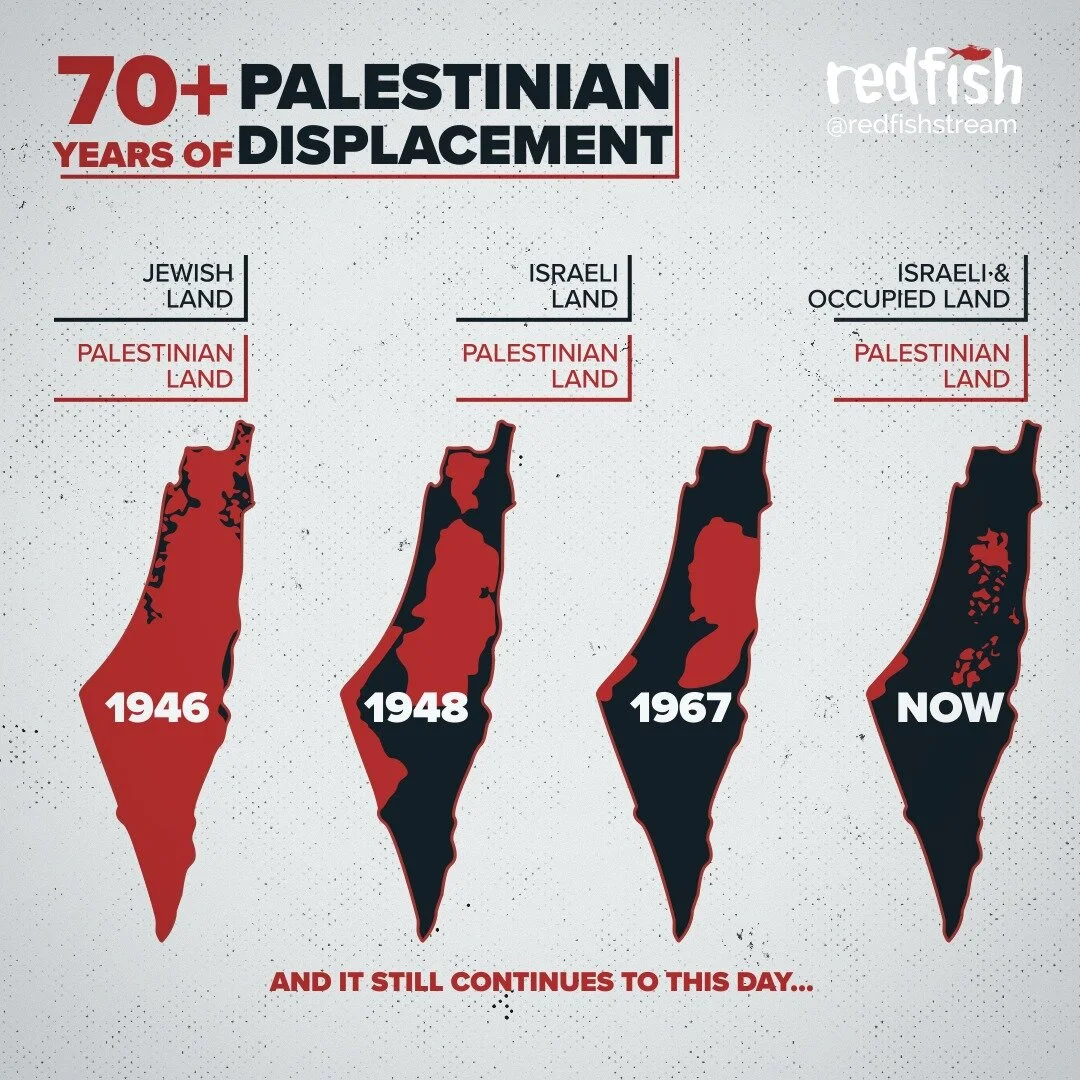
The expansion of Israeli territories as Palestinian lands shrink, by Palestineportal.org (recreated by Redfish media)
I came back to Palestine eight months after my first visit. My colleague Sonia Bajona and I received a scholarship to develop our own projects there. We spent three months in Palestine. In that time, we wrote a book which collects 12 first-person written stories and explores how the occupation affects Palestinians in different spheres of their lives. “A land without people for a people without land” was the slogan through which the Zionist movement justified many of the actions committed against Palestinians during through the decades. We decided to name the book “A land with people”.
Najia is one of those people. She lives in Dheisheh refugee camp as well, although she is originally from Deir Aban, a town near Jerusalem to which she cannot return to anymore. Her house is like a museum dedicated to her son Moataz, who was killed by the Israeli soldiers in a demonstration while he was protesting the imprisonment of his brother Ghassan. Ghassan has been intermittently in jail for more than one decade. He has been - and currently is - arrested under administrative detention. “This implies that they [the Israeli forces] do not need any proof to imprison you because the suspicion is enough”, Ghassan explains.
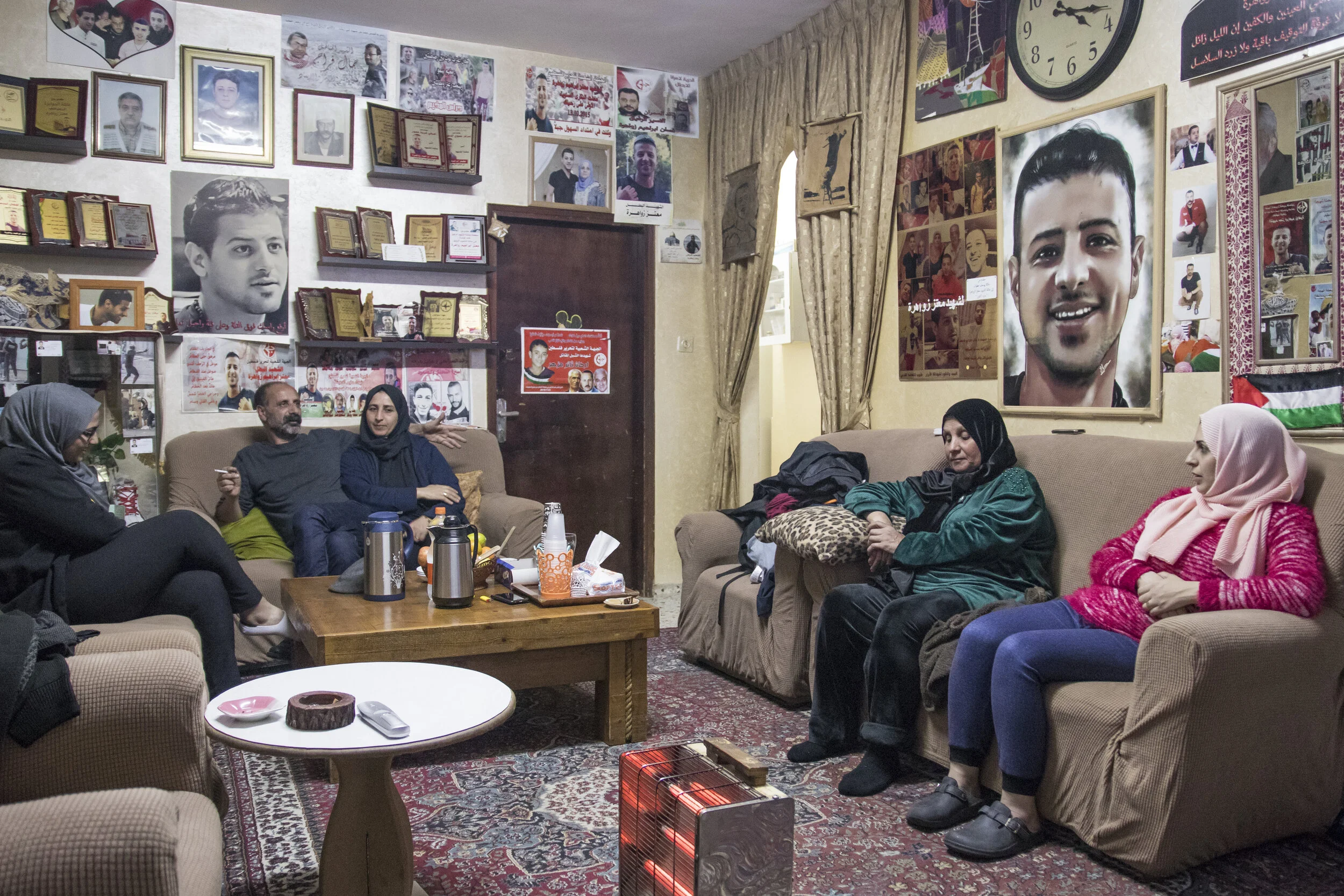
Najia’s house. Picture by Pablo Santiago for the book “A land with people”
According to Addameer, Prisoners Support and Human Rights Association, more than 800,000 Palestinians - which constitutes almost 20% Palestinian population in the occupied territories - have been arrested since 1967. Ghassan discussed that in jail the Israeli forces try to break them physically and emotionally and to depoliticize them. “They have many ways of doing this: from controlling the smallest things - like our access to lighters, food or our exits to the backyard - to extreme physical violence”, Ghassan says. Nevertheless, the process of leaving jail and aftermath is also hard. “The fear of being arrested again has serious consequences on our daily lives and on our families’ lives as well. The truth is that when we get out of jail, we enter a larger prison”.
Ghassan was detained again two months after he was released. Weeks after we interviewed him, the Israeli army came to the camp at night and arrested him violently in front of his children at his home, while his mother Najia tried unsuccessfully to deter the soldiers. He has been imprisoned since that day in December 2018.
Children are also detained by the Israeli army, some of them as young as 12 years old. The most common charge is throwing stones.
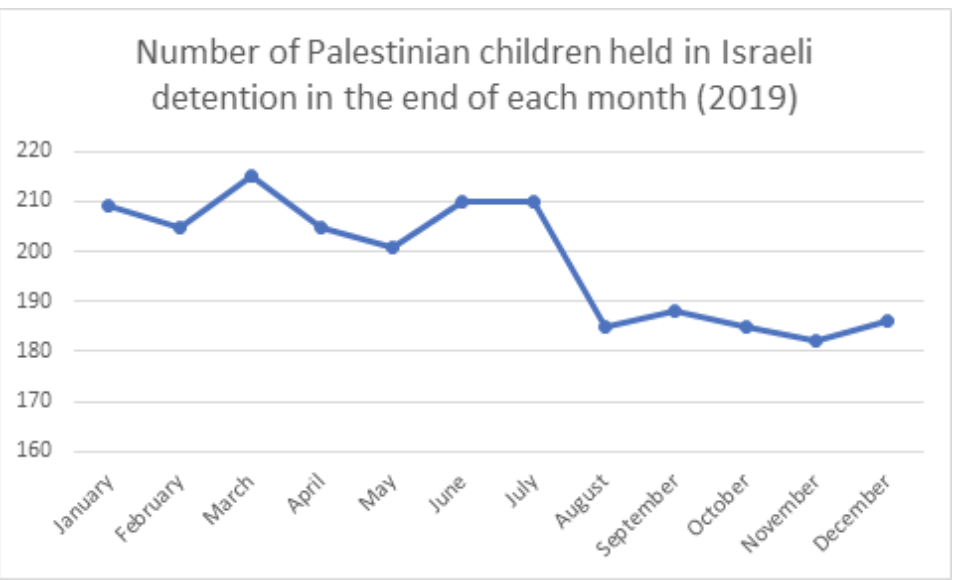
Source: Defense for Children International Palestine
Whether it’s in their homes, front yards or on their way to school, the threat posed by Israeli military forces is an everyday reality for many Palestinian children. The exposure of mistreatment and brutality towards Palestininans is amplified through video-recorded instances shared on social media.
This video below has been made popular by Lebanese music group Mashrou’ Leila, showing the reality of the arrests against Palestinians.
Mashrou' Leila - Cavalry (Official Music Video) | 2019
Physical violence is not the only thing that is used to make Palestinians’ lives unbearable. There are many other ways through which the Israeli occupation pushes them to leave their houses. The checkpoints, the limits to free movement and the constant humiliation influences life as well. “The Israeli forces, instead of putting all the Palestinians in lorries and taking them away, create this coercive atmosphere to foster us to leave”, explains Ahmad, one of the persons we interviewed for the book. During the time we interviewed him, he extensively spoke to us about the wall that separates the West Bank and the land that is considered to be Israel nowadays. Ahmad explains that, in words of the Zionist movement, the wall was built to preserve Israelis’ security. Nevertheless, the truth is that by building it, the Zionism has confiscated 10% of the Palestinian land. “This physical separation implies that we become the others for them; we are now those savages, those murders, those terrorists that are behind the wall. The dehumanisation, homogenisation and stigmatisation of Palestinians is very useful for them to turn us into the enemies and reinforce the Zionist ideology”, Ahmad states.
Decolonizing Palestine
There are few countries that do not recognize Israel as a legitimate state or that have cut international relations with it. Western governments see Israel as an essential and ‘unconditional’ ally in the Middle East that helps to control and protect the rest of the world from the Arabs, the others. Dominant media and the Western countries have put a lot of effort into depicting what’s going on in Palestine and Israel as a conflict, but as the poet Rafeef Ziada says in one of her texts: “These are not two equal sides, occupier and occupied”.
Rafeef Ziadah - 'We teach life, sir', London, 12.11.11
Furthermore, for years Israel, helped by the Western Powers, has spread the image of being a modern, ‘tolerant’ country. Pinkwashing -the externalisation of the idea that it is a LGTBI friendly and feminist country- has been one of the Israeli government’s main strategies to approach western societies’ approval and diverting attention from atrocities committed against Palestinians. Pink-washing is not just a strategy to idealise Israel, but to underlie how modern they are in comparison to their retrograde Palestinian neighbours which reinforce the cliches towards the arab population. The reality is that an ethnic cleansing has been - and is- taking place in Palestine and pink-washing allows people to be indifferent to this. The vilification of Palestinians has normalised their erasure from their homelands.
Nevertheless, being aware of this cannot lead to a tendency to view Palestinians in a pitiful way. They have been organised and resisting the occupation for years. Naji Owdah is the director of Laylac, a grassroots organisation that develops diverse activities in Dheisheh Refugee Camp with a very critical perspective. “Western societies see us refugees as poor, uncultured persons who live in a country where there are just bombs and deaths. Influenced by these stereotypes, some come here to help us or teach us. They treat us in a paternalistic way and with a charitable attitude because deep inside they see us as inferiors”, Naji explains. For Naji, the key is to see each other as equals and join forces. “What happens in Palestine is not something isolated, we are all living under the oppression of the capitalist system”, he says.
What can be done?
When we asked Palestinians what can be done from abroad, they always would refer to the BDS campaign. BDS is the acronym for Boycott Divestment and Sanctions to Israel. The BDS movement was born in 2005 when several Palestinian organisations asked local and international movements to boycott, divest and sanction Israel as a form of nonviolent pressure on Israel. The BDS movement is inspired by the anti-apartheid South African movement and although some contexts may vary in the two cases, the ethos and vision remains the same; to support Palestinians to live in dignity and have the right to build their futures. ‘To exist is to resist’.
The call for Boycott, Divestment and Sanctions;
Boycotts: involves withdrawing support from Israel's apartheid regime, complicit Israeli sporting, cultural and academic institutions, and from all Israeli and international companies engaged in violations of Palestinian human rights.
Divestment: campaigns urge banks, local councils, churches, pension funds and universities to withdraw investments from the State of Israel and all Israeli and international companies that sustain Israeli apartheid.
Sanctions: campaigns pressure governments to fulfil their legal obligations to end Israeli apartheid, and not aid or assist its maintenance, by banning business with illegal Israeli settlements, ending military trade and free-trade agreements, as well as suspending Israel's membership in international forums such as UN bodies and FIFA
Source: BDS.org