
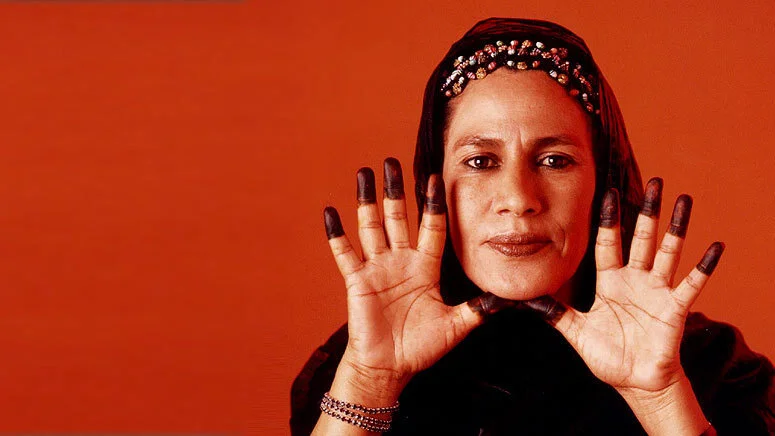
Mariem Hassan: The Voice of Sahrawi People
Written by Reem Al-Awadhi
Roots and Exile
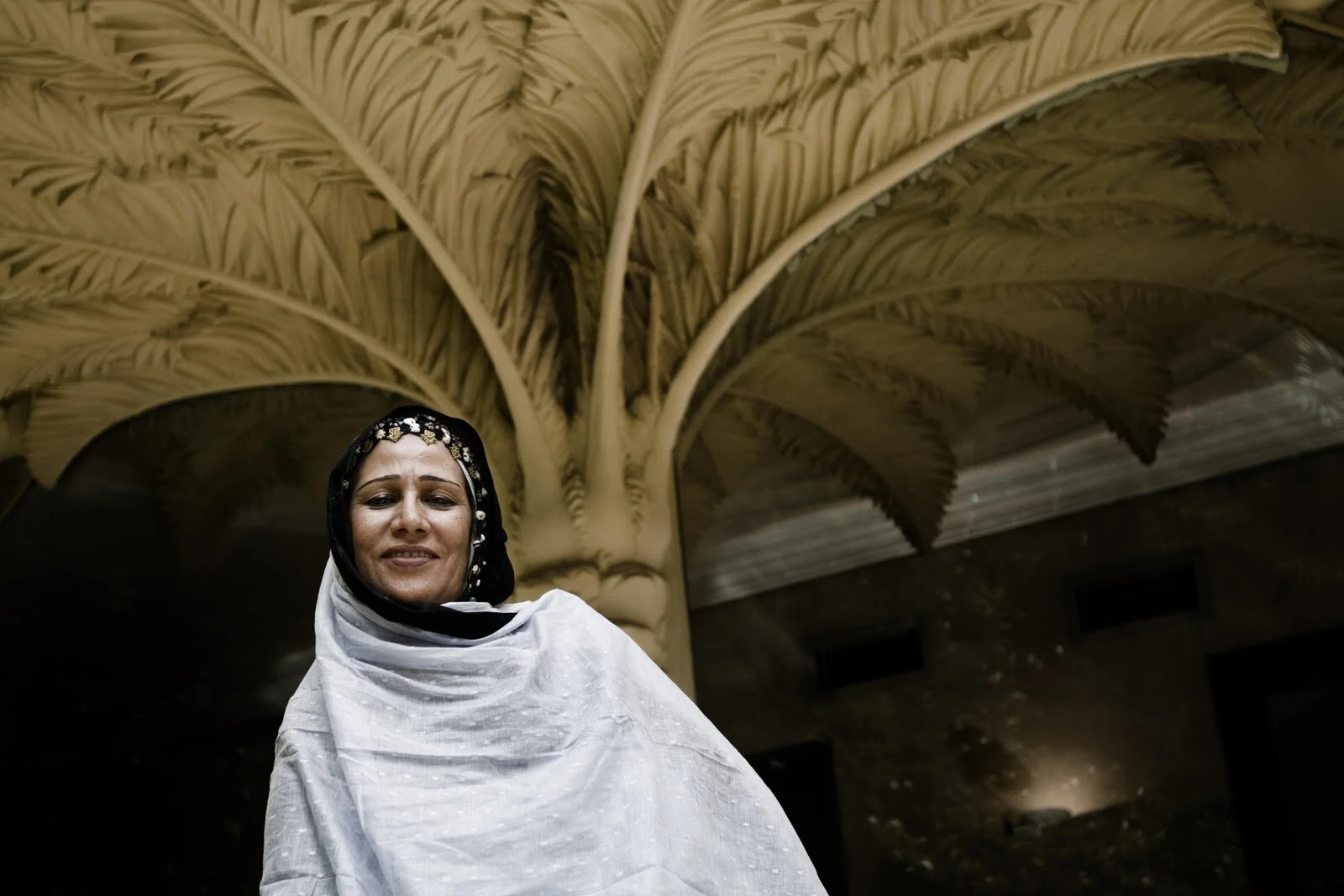
62 years ago, in what was known as the Spanish Sahara, Mariem Hassan was born to a nomadic family at the banks of El Gaiz river, 20 km from the occupied city of Smara. Mariem’s childhood was not short of energy and life, she grew up among 10 brothers and sisters and her parents. From a young age, she would follow the footsteps of her mother, who sang at weddings and religious ceremonies (Madeh) - every Thursday on the eve of the Islamic holy day, where the women would gather and sing spiritual verses, praising the prophets and beauty of their creator.
“I remember I used to gather with my friends in tents around a tabel (traditional percussion) or anything of that sort and we would sing prophetic verses. This kind of environment gave life to a strong feeling and leaning without any limitations towards music and singing” She continues, “since the seventies and the beginning of the [sahrawi] revolution, I developed a different kind of relationship with music...I would use old poetry and music and transform it with new words to match the spirit of revolution, anti-colonial sentiment, and to speak out against the occupation of our homeland.” Mariem talks about the beginning of her musical journey.
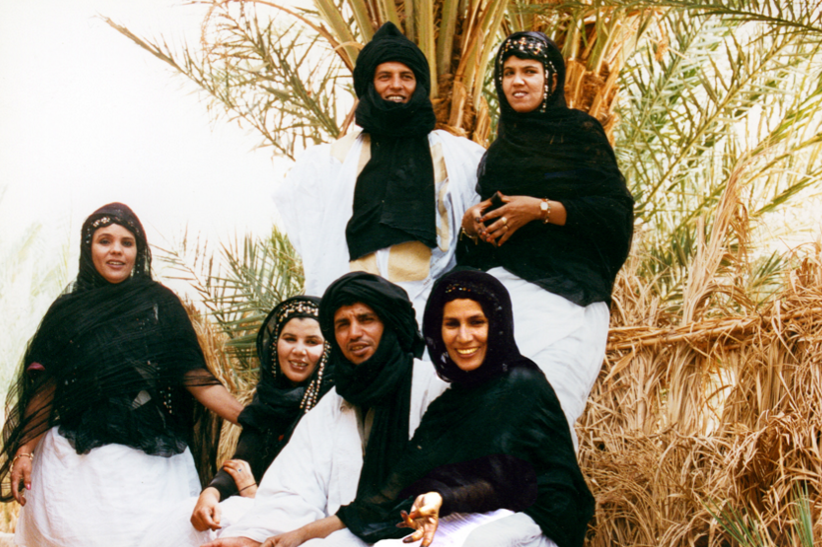
In these spaces, music and poetry were vessels for the continuation of Sahrawi culture and traditional practices, which were restricted by Spanish colonial authorities. Cultural festivities and gatherings were seen as a threat, but there was a discrepancy in that system. Women were not viewed to have influence in the eyes of these authorities. Weddings and religious ceremonies were allowed since they did not pose a political threat to occupation. Little did they realise that the voices of fearless women were born out of these spaces, and the roots of rebellion and resistance were instilled in Mariem when she discovered that her voice was her freedom.
In August 1975, Mariem was singing at a secret celebration held by the Polisario, a Sahrawi national liberation movement who were fighting against Spanish colonisation at the time, when it was broken up by the police and she managed to make a swift escape through a window.
“They had released some Western Saharawi prisoners who’d been arrested by the Spanish. I joined the big celebration party. This was the first time I’d seen a guitar. A boy was playing it and I was singing. The Spanish police came with nightsticks in hand so we all ran as fast as we could. I jumped out the window. I was 15 years old.”
Amid increasing pressure for decolonisation from Polisario, the UN and Morocco, Spain withdrew its colonial rule over Western Sahara, this transition left many people vulnerable to an abrupt scarcity of resources and conflict for successive control of the region.
“I cannot forget the times when Spain closed down everything. They closed the bakeries, they cut off gas, the shops and food stores were closed. We were left without anything.” Mariem said in an interview in 2008.
Shortly after this, Morocco began its annexation of her homeland with ruthless bombing and military takeover, rendering half of the Sahrawi population, including Mariem and her family, into refugees in exile.
In this video above, Mariem performs La Tamchu Anni (Don’t Leave Me) a desert blues song that encapsulates the feeling of looking back as you’re leaving a home behind.
Bringing the Sahrawi cause to the world
It took 20 weary days of travel, mostly during the night so they would not be spotted by opposing forces, for Mariem and thousands of refugees, to reach the Algerian border, where they were transferred in truckloads to refugee camps in Tindouf, Algeria.
“We were so happy, when the UN became involved and a truce was reached. We said this is it, we are very close to returning to our homes, but most importantly, the war was coming to an end. People were keeping their belongings packed in boxes, we stopped all activities. We believed that we would go back”
Days, months and years passed and to their disappointment, the Sahrawi refugees were never able to return as a wall was built in the middle of the Western Sahara to keep people like Mariem from returning to her town. Within the next 20 years, Mariem worked as a nurse, she was an organising leader in her camp, she got married twice, she gave birth to five children, all the while representing the Sahrawi voice at cultural arts festivals.
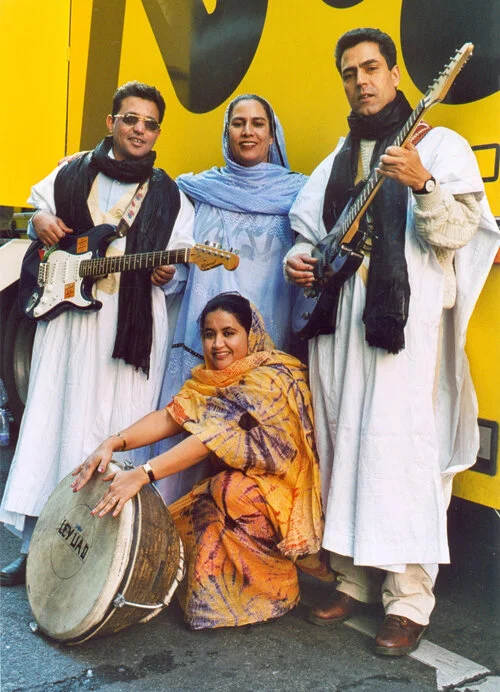
“For me Mariem Hassan is a comrade in battle, when we arrived at the refugee camps fleeing Moroccan invasion, we were more or less the same age, we had a share in much of the work of organising the camps of that time and later for me she was the voice that expressed the joys and sorrows of the Saharawi people. Celebrating our resistance and remembering key events in the fight of the Sahrawis”
- Jadiyeti Mojtar - Member of the National Union of Sahrawi Women.
Mariem was part of a national band called El Uali, where she was able to travel across countries and festivals to capture audiences with her powerful voice. She sang Haul (traditional Sahrawi music) and merged traditional percussion instruments with a twist of blues through uniquely tuned electric guitars. She brought to light the struggle of the Sahrawi people to an international stage and made herself part of the history of a nation without land.
“I personally am not allowed to enter [occupied Western Sahara] but my songs represent me as if I was there. I encourage young people in occupied areas, those women who are there through the music“ Mariem said in an interview.
When many narratives portrayed non-Western women as victimised, powerless and in many cases likened tradition to backwardness, Sahrawi women’s music and performances told a different story. On stage, with thousands listening to her, Mariem wears the traditional Malhaf dress, and sings about strength, freedom, and equality. Her agency on stage leaves one to assume that she is in control of her destiny. Moving from centre stage to play on the tabel drums, and move in rhythm towards her fellow band members on the guitar, Mariem shows that she can be more than one thing at once, but most importantly, that her power is from within her people.
A compilation video of Mariem performing Yasar Geidu, a revolutionary song in various venues around the world.
Legacy and message
“I thought that I would sing about my cause and culture until I was 35 or 36 because I thought my age would not allow me to continue with the music.”
Nevertheless, Mariem persisted through many hardships of loss and her music continued until much later in life. In 2005, her solo album Desos (Wishes) was released. This album was a deep unearthing of her pain and the weight she felt on her shoulders.
Songs like ‘La Tumchu Anni (Don’t Abandon Me) with deep desert blues, Chouhada (Martyrs) which was dedicated to her three brothers who were killed in the Western Sahara War, and “Mutamaniyat” (Wishes) where she asks God to heal her from breast cancer. She sings,
Rabbi (My God) heal me
from what happened to me
Rabbi heal me from what occurred
I am pleading with you God,
who is knowledgeable,
heal me
Oh my loved ones, my family, and friends
ask God for my healing
Video above, filmed during her struggle with breast cancer, Mariem sings Mutamaniyat (Wishes).
In her lyrics, asking for healing, Mariem feels like she is not ready to leave her family, loved ones, and the Sahrawi cause behind.
Needless to say, Mariem lived through major changes and she fought hard throughout her life. When she was 13, her parents forced her to marry someone who was 25 years old. On the night of her wedding, she fought for her life and escaped the grip of the man and hid in her brothers’ tent. With their help, she successfully filed for a divorce. When she was 17, she fought for her life during her escape from bombs. She gave life as a mother, she saved lives as a nurse and at age 47, she fought against breast cancer and had a successful operation. She continued to sing until days before she passed away in 2015.
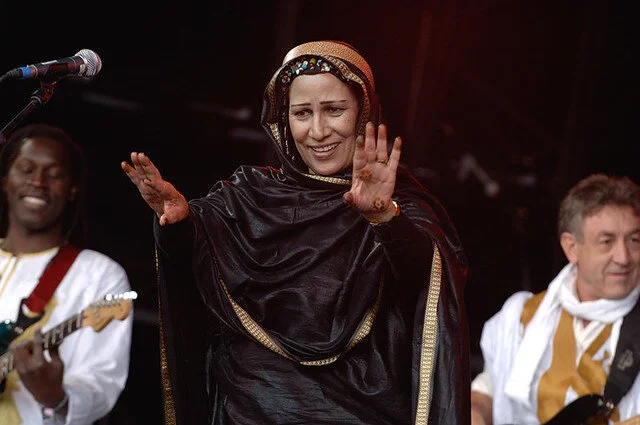
Mariem’s energy brought healing unity, one can hear her pain, but also feel her carrying the weight of Sahrawi cause with an optimistic vision of the future.
"My voice belongs to my people. It's in their cars, in their homes, their mobile phones in their stores. My songs are about the tortured and the prisoners, the resistance on the street and in the universities."
Until 2016, the United Nations considered Western Sahara partially controlled by the self-proclaimed Sahrawi Arab Democratic Republic and partially occupied by neighboring Morocco. The struggle for a Sahrawi homeland continues as they await for a referendum that would allow them to be an independent, sovereign nation.
In 2016, the European Union declared that "Western Sahara is not part of Moroccan territory”, which caused Morocco to expel more than 70 U.N. civilian staffers who worked with MINURSO (United Nations Mission for a Referendum in Western Sahara) and for recognising the annexation of Western Sahara as an occupation.
In times of ever increasing global division, injustice and suffering, Mariem Hassan’s voice embodied strength, her age was wisdom, and her stage presence carried the joyous energy and strong spirit of the Sahrawi people. Her performances bring a human story, of what is otherwise represented as a map of disputed territories and borders. As we listen to her music we feel her echoing message and a hope that her spirit, although no longer physically with us, continues to bring unity and healing as she rests in power.
—
Listen to more of Mariem’s most recent album here.
Further reading/viewing links:
[1] The Voice of the Sahara Documentary, Youtube, 2008.
[2] Mariem Hassan: the voice that brought the Sahrawi cause to the world, Raseef 22, 2016.
[3] The Remarkable Artists and Activists of the Western Sahara, Cultures of Resistance.
[4] Nubenegra records: Mariem Hassan